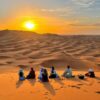
Camel trekking in Morocco’s Sahara Desert is one of travel’s most iconic experiences — an activity where the journey itself, not just the destination, is the point. The forty-five-minute trek from Merzouga village into the heart of the Erg Chebbi dune field on dromedary camelback, arriving at the traditional Berber camp as the sun descends, is a sequence of sensory experiences that most travellers describe as among the most memorable of their lives. This guide prepares you for every aspect of the experience.
Understanding the Dromedary Camel
The dromedary — the one-humped camel native to North Africa and the Middle East — is the animal you will ride. Dromedaries are not domesticated in the conventional sense; they are working animals that have been bred and trained for desert transport over approximately 3,000 years. The hump stores fat reserves (not water, as is commonly believed) that allow the animal to go without food for extended periods. A healthy dromedary can carry up to 200 kilograms and walk 40 kilometres per day in desert conditions. In the Erg Chebbi context, your camel will carry you for approximately three kilometres at a slow walking pace over soft sand — a comfortable and unhurried journey.
The Mounting Process
Mounting a camel is the aspect of the experience that surprises most first-time riders. The camel sits on the ground for mounting, and rises in two distinct stages: first the back legs straighten, pitching the rider forward at a steep angle, then the front legs straighten, pitching the rider briefly backward. Both transitions are pronounced and unexpected. The Berber guide will hold the camel’s halter during mounting and instruct you to grip the front saddle horn with both hands. Within a few metres of the starting point, the camel’s walking gait settles into a slow, swaying rhythm that most riders find surprisingly comfortable and meditative.
Practical Tips for the Camel Trek
Wear long trousers to protect the inner legs from saddle friction. Bring a scarf or shemagh to protect against sun and wind-blown sand. Closed shoes are more practical than sandals for mounting and dismounting. Carry only a small bag — leave larger luggage in the vehicle. Ensure your phone or camera is fully charged and protected from sand in a pocket or small bag. Children from approximately four years old can ride with parental support. A mild ache in the inner thighs the following morning is normal and temporary.
Camel Trekking Included on Our Tours
All our desert tours include the sunset camel trek and sunrise return as standard. Our 3-Day Merzouga Desert Tour from Ouarzazate to Marrakech and Tours from Errachidia both provide this experience as the central highlight of the desert overnight. Browse our tours from Ouarzazate and tours from Errachidia for all camel trekking options. Lonely Planet Morocco Travel Guide and UNESCO — Medina of Fes provide further Sahara travel context.